

Who Draws The District Lines In Arkansas
The one time-a-decade boxing to redraw the U.S. political map is underway based on findings from the 2020 Census – a constitutionally mandated count of every person living in the U.S. that happens every x years. We reply your questions and help you strategize for changes to come up with an overview of who draws congressional districts (and when redistricting occurs), how the redistricting process works, and projections from the 2020 Census.
Essential Intel in 1 Place
We tin aid you strategize effectively by providing the news, assay, and tools you need – state and national – inside a single platform. Asking a demo to larn about our custom news alerts, legislative and regulatory tracking, state and congressional directories, and more.
Request Demo
Who draws congressional districts?
States take unlike processes for drawing congressional districts – and unlike governing bodies in charge, including Republican- or Democratic-controlledstate legislatures. Some states have divided government, while in others the line will be drawn by independent or bipartisan commissions.
The party in charge can oft redraw those lines to give itself an advantage. By dividing the opposition party'southward likely voters among several districts, partisan mapmakers can craft strong and hard-to-flip districts for their party, a process known as gerrymandering.
Six states adopted new systems for drawing lines, intended to force bipartisan consensus, sometimes by using commissions. Partisan ability all the same carries considerable influence in 28 states.
The path to a committee
Though legislators nonetheless take charge of redistricting in most states, a growing number of states have been shifting power away from legislators in favor of commissions. In 2000, Arizona voters approved granting redistricting power to an independent commission – a election measure intended to terminate gerrymandering.
The Arizona committee comprises five members: two Democrats, two Republicans, and an independent chair. Lawmakers appoint the four partisan members from a pool of applicants, and the partisan members select the independent chair. Though lawmakers play a role in selecting the commissioners, they practise not get to vote on the updated maps.
Watch: Who Draws the Lines – Monitoring Developments in Redistricting
This webinar, featuring assay by Bloomberg Government and the National Conference of Land Legislatures, provides an overview of who draws congressional districts, how the redistricting process works in various states, and early projections that tin be made on the outcome.
When does redistricting occur?
The redistricting process starts with the release of data from the Census, a constitutionally mandated count of every person living in the U.Due south., which happens every 10 years. The count volition decide which states gain seats in the U.S. Business firm of Representatives, and which ones lose. (The Senate count remains the same, with two members from each state, elected statewide, regardless of population.)
State population numbers are due at the end of the year in which the Census was conducted. Results from the 2020 Census were due December 31, 2020, but were delayed until April 2021 because of the Covid-nineteen pandemic.
On August 12, 2021, the U.S. Demography Bureau released another gear up of numbers with cake-by-block population counts.Census blocks – laid out once every 10 years – are statistical areas defined by geographic features and nonvisible boundaries, like railroad tracks, roads, or property lines. These designations allow states to draw districts of equal size to business relationship for population shifts over the past decade.
How often does redistricting occur?
States redraw legislative district boundaries every 10 years. Courts may invalidate maps mid-decade and either impose new lines or directly legislatures to do so, as was the example terminal decade in Florida, Northward Carolina, Virginia, and Pennsylvania.
How does the redistricting process work?
Following the completion of the Census, most states retain the same number of congressional seats – but some proceeds or lose seats in the Business firm through reapportionment.
- U.S. Census Bureau delivers initial land population numbers to states.
- The bureau delivers a 2d set of detailed, block-by-cake population counts to states.
- States can begin the redistricting procedure according to their respective systems.
- Still, police requires that the districts be about equal in population.
How congressional districts are determined and drawn
States can begin redrawing congressional district maps when they get the detailed figures from the Census Bureau – which count the number of people down to the block level. This data is important to ensure that every district within the aforementioned state is of about equal population.
Mapmakers have latitude in how they redraw district lines, though the Constitution requires that districts exist about equal in population, and the Voting Rights Act holds that maps can't impairment voters based on their race or ethnicity.
State constitutions and statutes may have additional rules or criteria.
How the 2020 Census will shape the 2022 political mural
Redistricting will have a major touch on the political landscape in 2022 and across – only it'due south also not the sole determinant in time to come election outcomes:
- Redistricting, performed past state legislatures or independent commissions, will ready up the fight for the House of Representatives for the side by side decade, starting with the beginning midterm election nether President Biden.
Democrats control the Business firm by less than half a dozen seats – ane of the smallest margins for either party in decades – and a shift of a few seats could tip power back to the GOP as shortly equally the 2022 elections.
- Redistricting doesn't guarantee results. Incumbent retirements, candidate recruitment, campaign quality, and Biden'south approval rating will affect the outcome of the 2022 elections.
Gainers & Losers from the 2020 Census
Texas gained the virtually seats in Congress, with states in the industrial Northward losing the about. California lost a seat for the first time e'er.
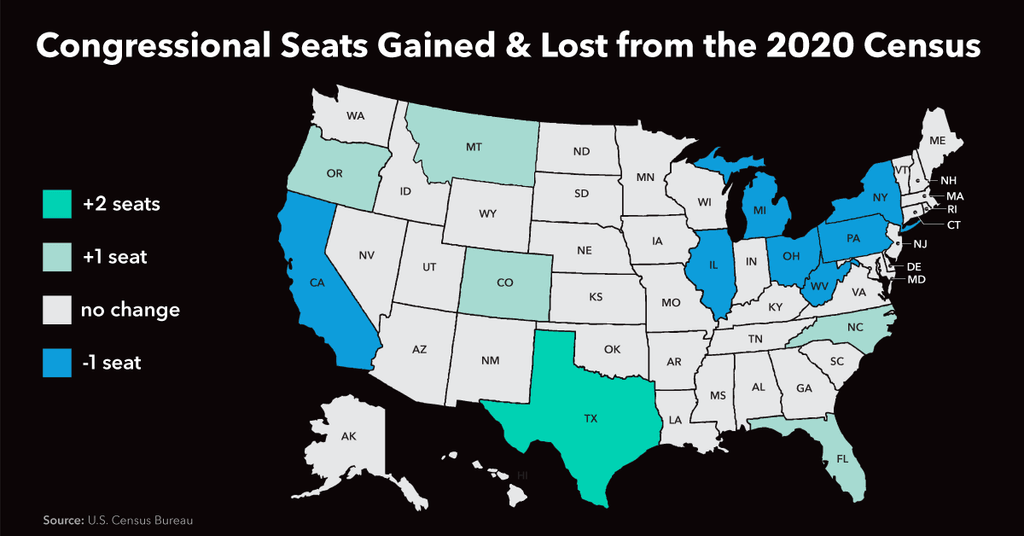
- Texas is the only state that gained ii districts while Colorado, Florida, Montana, North Carolina, and Oregon each won one additional seat.
- vii states lost one seat: California, Illinois, Michigan, New York, Ohio, Pennsylvania, and West Virginia. California lost a seat for the first time e'er.
- New York lost a seat after falling short by just 89 residents, though it was in danger of losing two districts.
- Dominicus Belt states benefited from booming Latino populations and from people moving from more liberal states – like New York.
Congressional Reapportionment and the 2020 Demography
Reapportionment is a null-sum game. For more than a century, House membership has remained at 435 – for one state to gain representation, another must lose.
- The full U.S. population for circulation was 331,108,434 as of April 1, 2020.
- The average House district volition have 761,169 people, up from 710,767 in 2010, though numbers vary widely by state.

Who Draws The District Lines In Arkansas,
Source: https://about.bgov.com/brief/who-draws-congressional-districts/
Posted by: mooreheadsoread.blogspot.com
0 Response to "Who Draws The District Lines In Arkansas"
Post a Comment